

NEW PAPER: Consistent effects of the Loop Current and associated mesoscale eddies on the vertical distributions of deep-pelagic fishes in a subtropical ocean basin

We have a new paper out in Progress in Oceanography this month, which you can find here: https://doi.org/10.1016/j.pocean.2026.103710
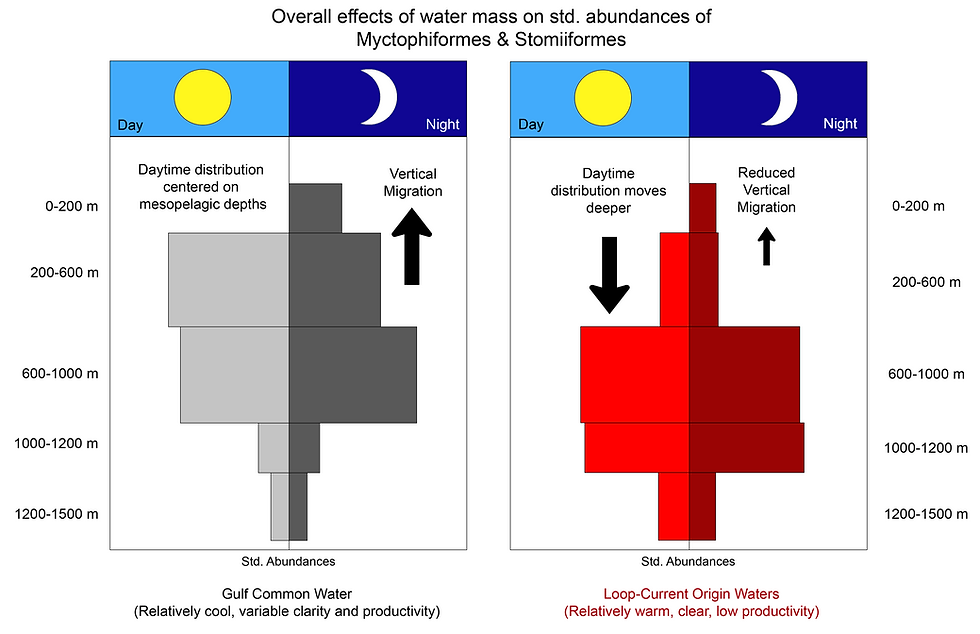
This work essentially examines the potential role of mesoscale eddies and the Loop Current on deep-sea fishes in the Gulf of Mexico. The Loop Current is a warm, low-productivity current from the Caribbean that flows northwards into the Gulf at semi-regular intervals, and has a distinctive physical and chemical signature compared to the rest of the water masses in the Gulf. It has been proposed previously that the Loop Current might essentially provide a distinct pelagic (open-ocean) habitat for mid-water organisms (based on those different properties) and/or potentially provide a pathway to transport animals from the Caribbean and/or the Atlantic ocean into the Gulf. To date however, we have only really had small-scale snapshot studies around the Loop Current, or studies that used active acoustic tools to look for general effects of the entire assemblage: no-one had conducted a detailed study of assemblage and species-level distribution patterns inside and outside the Loop Current to examine its potential impacts.

Our new study does just that: it provides a pretty comprehensive analysis of biodiversity, assemblage, and species distribution patterns for the midwater fish assemblages, and make comparisons between trawl catches made inside and outside of mesoscale eddies over a series of four cruises. Our results highlight how these oceanographic features consistently influence both the assemblage structure, and lead to changes in the vertical distributions and migration rates of species in the region. We even see evidence of vertical distribution shifts in Cyclothone spp., which is typically considered an entirely non-migratory species. We certainly don't observe the genus migrating over large distances (e.g., to the epipelagic at night), but there is clear evidence that several species distributions change depending on whether they are found in Loop Current waters or residual Gulf waters. While we can't disentangle the causes of these observations from the data we currently have, we believe that differences in light levels between the low-turbidity Loop Current waters and more turbid Gulf waters may offer a likely explanation for the observed results. Light is known to be important in structuring the vertical distributions of midwater species, and we suggest that species may be moving deeper in the clearer (Loop Current) waters to remain in their preferred light ranges, while potentially curtailing their migrations at night to avoid visual predators.
This work is part of the DEEPEND|RESTORE II research program (https://restore.deependconsortium.org/)

Comments